Woody Line Font: Playful Display Type for Handmade Labels & Printables
If you’ve ever spent 20 minutes searching for a font that feels joyful but still cuts cleanly on your Cricut, prints crisply on kraft sticker paper, and makes your boutique candle labels look like they belong in a curated gift shop—you’ll understand why Woody Line Font landed in my cart and hasn’t left my design toolkit since.
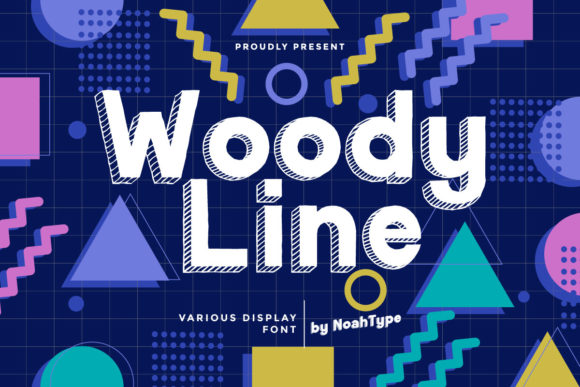
Woody Line is a comic-inspired display font with soft, rounded letterforms, gentle irregularities, and just enough bounce to feel handmade—without sacrificing legibility. It’s not overly cartoonish or childish; instead, it carries the warmth of hand-drawn signage you’d see at a neighborhood farmers’ market, a cozy children’s bookstore, or a family-run bakery. The strokes have subtle variation—like ink pressed slightly unevenly onto paper—which gives printed pieces organic texture and approachability.
For crafters and small shop owners, this kind of personality matters. Your product label isn’t just functional—it’s the first impression. Woody Line instantly signals friendliness, creativity, and care. I’ve used it for lavender-scented soap tags, “Welcome to Our Wedding” chalkboard-style signs, and even as the headline font on printable baby shower games—and each time, customers commented on how “inviting” the typography felt.
It shines brightest in short-form display use: product names (“Honey Lavender,” “Tiny Tots Storytime”), event titles (“Summer Picnic Party”), shop signage (“The Cozy Cupboard”), and decorative phrases (“Eat. Laugh. Repeat.”). Its generous x-height and open counters mean it remains highly readable—even at 18pt on a 2x3” sticker or when scaled down for jar labels. Just avoid using it for full paragraphs or ingredient lists; it’s a display font, not a text face—and that’s exactly where its strength lies.
On cutting machines, Woody Line performs reliably. I tested it across Cricut Maker 3 and Silhouette Cameo 4 using both vinyl and printable sticker stock, and found clean cut lines on letters like “a,” “e,” and “g”—no fragile serifs or thin connecting strokes to snag or tear. For SVG creators, the outlines are smooth and well-structured, making it easy to convert into layered designs or add subtle shadows and outlines in your mockups.
Real-world projects where Woody Line consistently delivers:
- Candle & soap labels: Paired with a light sans serif (like Montserrat Light) for ingredients and weight details—Woody Line becomes the hero name that draws the eye on a shelf.
- Printable wall art: Used in 72pt+ sizes with a soft watercolor background, it adds instant charm to nursery or classroom decor without looking dated.
- Wedding welcome boards & seating charts: Its casual elegance bridges rustic and modern—especially when printed on textured cardstock or mounted on reclaimed wood.
- Children’s activity printables: Works beautifully for title pages, instruction headers, and reward certificates—engaging without overwhelming young readers.
- Seasonal packaging: Think “Pumpkin Spice Season” on autumn mug wraps or “Jingle All the Way” on holiday cookie box stickers—it adds festive energy without cliché.
Font pairing is intuitive and effective. Try Woody Line with a relaxed script (like “Dancing Script” or “Pacifico”) for greeting cards or invitations—where the script handles names and dates, and Woody Line anchors headlines. For cleaner contrast, pair it with a neutral sans serif (like Lato or Open Sans) in your digital templates or product tags. If you’re building a cohesive brand identity, Woody Line can serve as your expressive accent typeface—while your body copy stays clear and scannable.
The file package includes standard OTF and TTF formats—fully compatible with Canva, Silhouette Studio, Cricut Design Space, Adobe Illustrator, and Procreate. While the description notes it’s ideal for comics, events, food, and children’s books, what stood out to me was its quiet versatility: it supports basic Latin characters and common punctuation, making it safe for English-language product labeling, Etsy listings, and printable downloads. There aren’t swashes or alternate glyphs listed, which keeps things simple—ideal for crafters who want charm without complexity.
One practical note before you download: check the commercial license. As a small shop owner selling physical goods, digital printables, SVG files, or custom-designed merchandise, you need a license that explicitly permits resale use. Woody Line is a premium font designed for commercial work—including client projects, template sales, and branded products—so verify the license covers your specific use case (e.g., unlimited physical products, digital downloads, or extended use for POD platforms).
Readability in mockups matters too. When previewing for Etsy or social media, render Woody Line at actual size—not zoomed in. On mobile feeds, it holds up best above 24px in headers; for printed cards, aim for minimum 28pt for main titles to preserve its friendly weight and spacing. And if you’re printing on kraft or recycled paper? Its slightly bold rhythm helps it stand out against muted backgrounds without needing heavy shadow effects.
What makes Woody Line different from other playful display fonts is its balance: it’s expressive but not exhausting, distinctive but not distracting, fun but never frivolous. It doesn’t shout—it smiles. And in a crowded handmade marketplace, that quiet confidence builds trust faster than any trend-driven design ever could.
Whether you’re designing a single batch of birthday stickers or building a full seasonal collection of printable planners and gift tags, Woody Line fits naturally into your workflow—not as a novelty, but as a reliable, customer-pleasing tool. It’s the kind of font that makes your products feel thoughtfully made, not mass-produced. And honestly? That’s worth every penny.