Djangos Display Font for Handmade Creators
If you’ve ever spent hours searching for a font that feels both distinctive and dependable—something that catches the eye without sacrificing clarity—you’ll understand why Djangos stands out in my design toolkit. As someone who makes printable planners, hand-stamped tags, Cricut-cut signs, and boutique packaging for small-batch makers, I need display fonts that do more than look pretty: they need to cut cleanly, print crisply, and communicate warmth and intention at a glance. Djangos delivers exactly that.
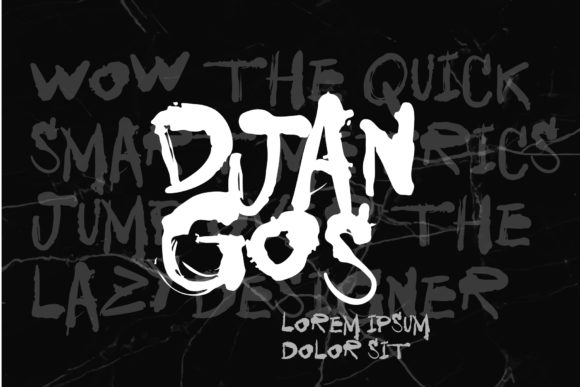
Djangos is an expressive, modern display font with strong personality—think confident curves, balanced weight, and subtle character. It’s not overly ornate, nor is it minimalist to the point of sterility. Instead, it walks a thoughtful line: friendly enough for a baby shower invitation, bold enough for a farmhouse-style wall sign, and refined enough for artisan soap labels or boutique gift tags. Its letterforms have gentle contrast and open counters, which means it remains legible even when scaled down to 12–16pt on product stickers or printed hang tags.
I reach for Djangos most often when designing for physical products where first impressions matter. For example, I recently used it for a set of seasonal candle labels—“Spiced Cedar,” “Vanilla Bean,” “Rainy Day”—and customers commented how “inviting” and “thoughtfully designed” the packaging felt. That’s Djangos doing quiet work: elevating perceived quality without shouting. It also shines on wedding welcome boards, where couples want elegance with approachability—not stiff formality. A phrase like “You’re Here” in Djangos, paired with a light serif or clean sans serif for details, creates instant cohesion and emotional resonance.
For digital creators, Djangos works beautifully in printable wall art, planner covers, and Canva-ready templates. Because its rhythm is consistent and spacing well-considered, it holds up across sizes—from thumbnail previews on Etsy listings to full-page PDFs. When layered over textured backgrounds (like kraft paper or linen overlays), its subtle stroke variation adds depth without muddying. And if your SVG files include layered text elements, Djangos cuts cleanly on Silhouette Studio and Cricut Design Space—especially when using the OTF version, which supports OpenType features like standard ligatures and stylistic alternates.
Readability matters most when scaling down. On 1-inch round stickers or tiny jar labels, I stick to short phrases—names, flavors, dates, or single words like “Hand-Poured” or “Small Batch.” Djangos stays sharp at 14pt in print, but below that, I test output on my Epson ET-2800 first. For laser-cut wood signs or vinyl decals, I avoid tight kerning adjustments unless manually fine-tuning; the default spacing handles most craft applications gracefully. Bonus: its uppercase letters have excellent presence for monogrammed tote bags or embroidered patches—no extra outlining needed.
Pairing Djangos thoughtfully expands its versatility. My go-to combo? Djangos for headlines + a warm, neutral sans serif (like Montserrat Light or Poppins Regular) for body text. This pairing keeps invitations, product cards, and shop banners balanced—expressive yet grounded. For vintage-inspired stationery, I sometimes layer it with a delicate script (not too flourished) for names or accents—just one line, never blocks of script text. The contrast gives hierarchy without visual noise. Avoid pairing Djangos with other high-contrast display fonts; it’s confident enough to carry the spotlight alone.
What really seals the deal for me is how Djangos supports real-world production needs. It includes both OTF and TTF formats—essential for compatibility across design apps and cutting machines. While the product description mentions “endless variations,” I’ve found those built-in alternates especially helpful for avoiding repetition in multi-item sets: swapping a swash ‘Q’ on a greeting card pack, or using a rounded ‘g’ alternate for a playful planner sticker sheet. If you’re creating multilingual printables (e.g., bilingual baby announcements or bilingual café menus), check whether the version you purchase includes extended Latin support—it’s not always listed upfront, but many premium display fonts like Djangos now include accented characters for Spanish, French, and Portuguese.
Licensing is non-negotiable when you sell physical goods or digital downloads. Djangos is a commercial font, and the standard license covers use in physical products (stickers, mugs, shirts), digital templates (Canva, PowerPoint), SVG bundles, and client work—so long as you’re not reselling the font file itself. I always verify the license terms before uploading a new printable bundle to Etsy or sending files to a print-on-demand partner. It’s peace of mind that pays for itself every time a customer says, “Where did you get that gorgeous font?”
In practice, Djangos has become my reliable “hero font” for moments that need distinction without distraction. Whether it’s a limited-run holiday mug collection, a set of editable bridal shower games, or custom bakery tags for a local farmer’s market vendor, Djangos consistently adds polish and personality—without demanding extra design labor. It doesn’t require shadow effects, outlines, or texture overlays to feel intentional. Its strength is in its simplicity: a well-crafted display font, made for makers who value both beauty and buildability.
So if you're choosing fonts not just for aesthetics—but for how they perform on vinyl, how they translate to mockups, how they reflect your brand’s sincerity and care—Djangos earns its place in your core font library. Not as a novelty, but as a working partner in your creative process.